Behind the VPN Illusion: Building Real Security with the Swiss Cheese Model
 Sharon
  2026.09.02
In the cybersecurity and VPN industry, flashy slogans like “100% Anonymous,” “Hacker-Proof,” and “Absolute Security” are everywhere. But a rigorous, transparent brand must face the technical reality: there is no such thing as absolute cybersecurity, and a VPN is not a magic cure-all.
To help you build a scientific approach to digital privacy, we are looking at security engineering through the lens of the famous “Swiss Cheese Model.” By breaking down how system defenses actually work, we will explore the boundaries of a VPN’s capabilities and show you how to stack your defenses to build a truly robust personal security ecosystem.

🧀 The Swiss Cheese Model: Why One Tool Is Never Enough
Originally used for risk analysis in aviation and healthcare, the Swiss Cheese Model is the perfect metaphor for digital defense.
Imagine your cybersecurity setup as a series of Swiss cheese slices stacked back-to-back. Each slice represents a specific defensive tool, and the holes in the cheese represent the inherent technical limitations (vulnerabilities) of that tool.
  THREAT ───►  [ Slice 1: PandaVPN ]  ──►  [ Slice 2: MFA & Passwords ]  ──►  [ Slice 3: Security Awareness ]  ──►  [ BLOCKED! ]
                 ( Holes: Doesn't         ( Holes: Doesn't stop              ( Holes: Human error/
                  stop phishing/malware )  local endpoint exploits )          zero-day exploits )
If you rely on a single layer—like only running a VPN—your defense is just one slice of cheese. Cyber threats (like malware, phishing, or social engineering) can easily pass straight through those holes and breach your privacy.
Security happens when you stack different tools (multiple slices) together. Because the holes in each slice are in different places, they cover each other’s gaps, effectively blocking threats before they can penetrate the final layer. In this model, a premium service like PandaVPN serves as your robust Slice #1, securing the network transport layer. However, it cannot do the work of the other slices.
Three “Security Holes” a VPN Cannot Plug
To build a flawless defense, you must understand what a VPN—as a transport-layer encryption tool—physically cannot prevent:
1. Social Engineering & Active Leaks
-
The Scenario: A hacker sends a highly convincing phishing email that tricks you into visiting a cloned online banking website.
-
The Reality: If you type your credentials into a malicious page, your VPN will faithfully, securely encrypt your password and safely deliver it directly to the hacker’s server. A VPN protects the data in transit, but it cannot stop you from handing over the keys to the front door.
2. Endpoint Malware & Device Exploits
-
The Scenario: You download a cracked software file or an unverified email attachment that secretly contains a keylogger or spyware.
-
The Reality: A VPN hides and encrypts the download process itself. However, once that malicious code executes locally on your PC or smartphone, it records your keystrokes directly in the system memory before the data ever reaches the VPN tunnel.
3. Account-Level Activity Tracking
-
The Scenario: You connect to a highly secure VPN server in the United States, open your browser, and log straight into your real, personally identifiable Google or Facebook account to search or shop.
-
The Reality: Platforms do not need your real IP address to track you at this point. They link your activities directly in the cloud using your active login session, search history, and browser fingerprinting.
Tactical Stacking: How to Build a Complete Digital Line of Defense
To stop threats from slipping through the cracks, you need to cross-block them using four distinct layers of digital hygiene:
-
Layer 1: Network Transport Encryption (PandaVPN)
-
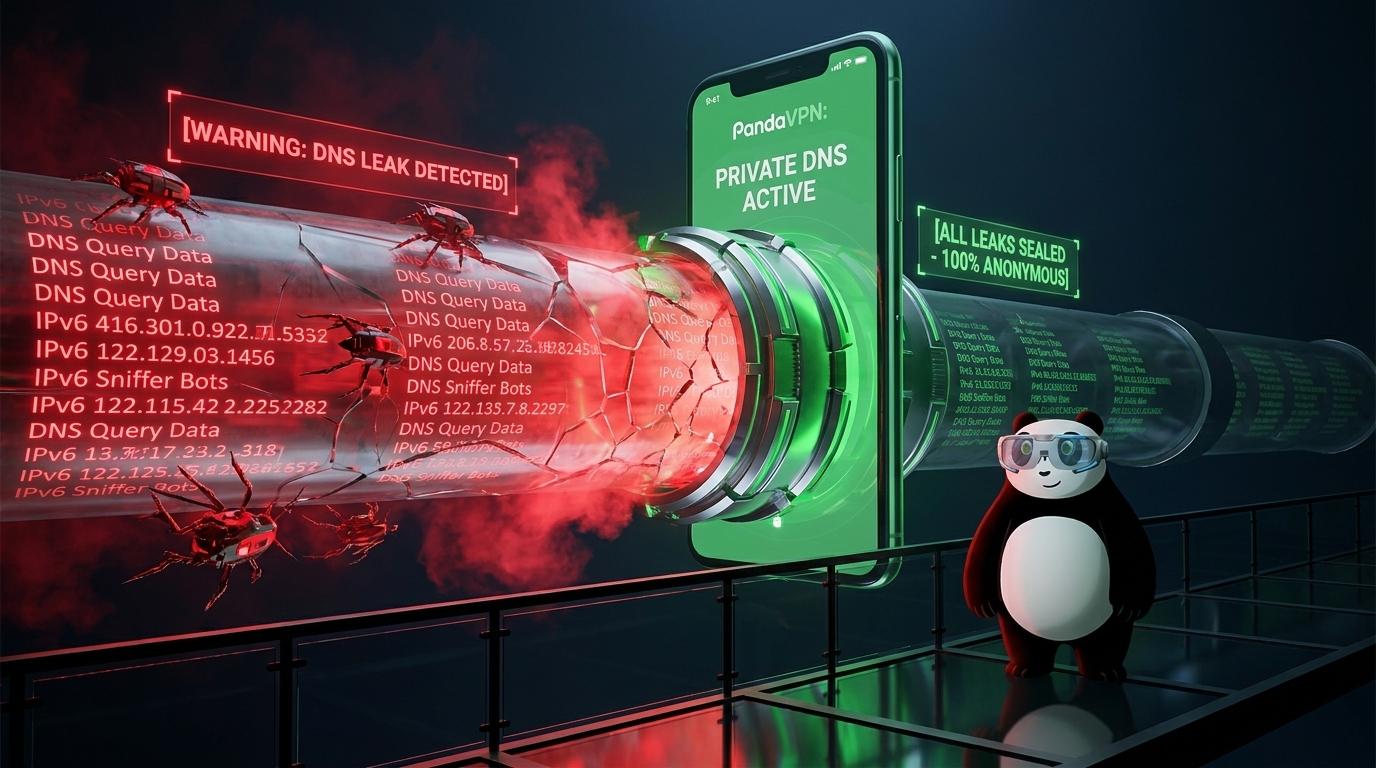
Role: Secures public Wi-Fi networks, stops ISP tracking, prevents DNS/IPv6 leaks, and masks your actual physical location.
-
-
Layer 2: Identity Decoupling (Password Managers + MFA)
-
Role: Enforces unique passwords for every site to eliminate credential stuffing attacks. If one platform’s database leaks, your primary email or banking accounts remain untouched.
-
-
Layer 3: Endpoint Protection (Firewalls & Antivirus)
-
Role: Keeps your Windows, macOS, iOS, or Android operating systems updated with the latest security patches while running active malware protection.
-
-
Layer 4: Digital Safety Awareness (The Human Element)
-
Role: Maintains a healthy skepticism toward unexpected links and taking three seconds to manually verify a browser’s URL domain before typing any sensitive password.
-
True Privacy Built on Transparent Engineering
We don’t sell illusions; we build defenses based on solid cryptography. Rather than promising a catch-all fantasy, we focus on engineering the ultimate First Line of Defense:
-
Patented Acceleration & Ultra-Fast Servers: Built with advanced network acceleration technology and 10Gbps high-bandwidth IPLC servers across 100 countries to ensure privacy never throttles your performance.
-
Strict No-Logs Policy: Operating under a verified no-logs standard to guarantee that your browsing history, traffic destination, and data content are never recorded.
-
Highest-Level ECC Encryption: Protecting every byte of your internet traffic with top-tier Elliptic Curve Cryptography (ECC), keeping your data safe from deep packet inspection and network snoopers.
-
Cross-Platform Protection: User-friendly, one-click connection clients tailored for Windows, Mac, iOS, Android, Linux, and Android TV to safeguard up to 20 devices simultaneously.
By pairing the scientific protection of PandaVPN with proactive digital habits, you can build a secure, multi-layered defense system that guarantees true digital freedom.

Related Posts

Featured Posts